What Happens on an AeroBarrier Day
A walk through a day of whole-building air sealing, from the first fan test to the final reading.
October 7, 2026 · 4 min read
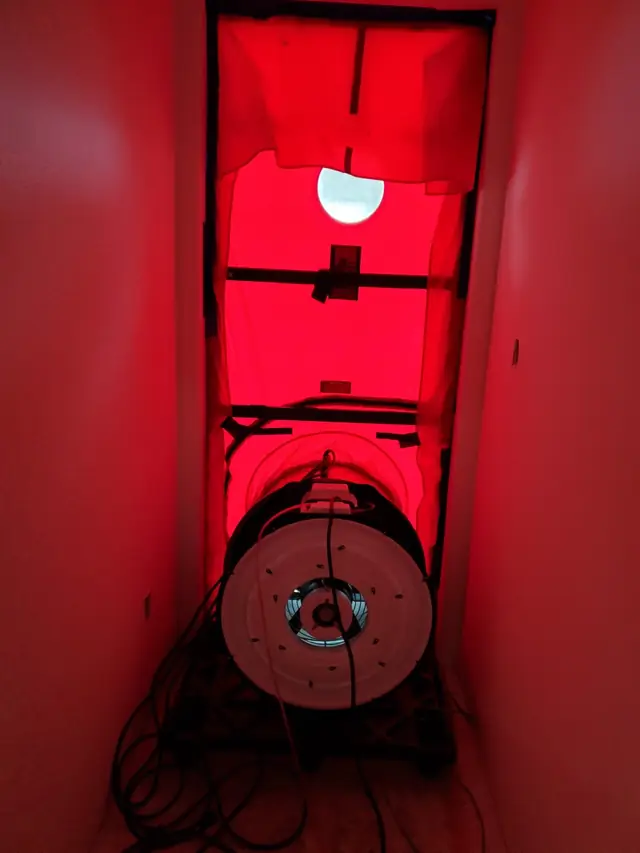
Air leaks are a hidden cost in a lot of buildings. Gaps around framing, outlets, windows, ceiling penetrations and rim joists let heated and cooled air slip outside and let outside air slip in. You can caulk what you can see, but most leaks sit inside walls and ceilings where nobody can reach them.
That's the problem AeroBarrier was made to solve, and Paul's AIR FX is the Eastern Washington AeroBarrier specialist for homes and businesses. If you've wondered what the day actually looks like, here is the sequence, start to finish.
First, a Blower Door Test
The day starts with measurement. A blower door is a calibrated fan mounted in an exterior door frame. It moves air through the opening, and gauges show how hard the fan has to work to hold a set pressure difference between inside and outside. A leaky building needs a lot of airflow from the fan. A tight one needs much less.
That first number is your baseline, so the results after sealing are measured instead of guessed. The same test also makes the invisible visible. With the fan running, you can feel drafts at gaps you would never have noticed otherwise.
Why the Building Is Closed Off
Before sealing begins, the building is prepared. Paul's AIR FX notes that, to ensure safety, the building is usually inaccessible during application, so plan to be out of the house or the shop while the work is underway.
Surfaces and openings that shouldn't be sealed are typically covered first. Ask the crew ahead of time what they will cover and what you should move out of the way. A short conversation the day before saves a lot of scrambling that morning.
The Sealant Mist Builds Up and Hardens
With the building prepped and closed up, the sealant goes in as a fine mist while the building is held under pressure. The pressure pushes the mist toward the leaks, because that's where air is moving. As Paul's AIR FX describes it, the sealant builds up and hardens, filling in gaps, cracks and spaces.
It doesn't coat the room the way paint would. It collects at the edges of the leaks and bridges them. And because the fan keeps running through the whole process, the leakage numbers can be watched as the gaps close, which is how the crew knows when the building has reached its target.
As Little as Three to Four Hours
According to Paul's AIR FX, the air sealing process can take as little as three to four hours. Compare that with chasing leaks by hand with caulk and foam across an entire building, which takes far longer and still misses the gaps you can't reach.
Total time on site depends on the size of the building, the preparation and the testing before and after, so ask for a plan that fits your property rather than assuming the shortest number applies to yours.
It Works After Construction Too
AeroBarrier is often associated with new builds, where sealing is easy to schedule before the finishes go on. But Paul's AIR FX says the process is designed to be applied post-construction as well. That matters in the Yakima Valley, where plenty of homes and commercial buildings were built long before anyone measured air leakage.
If you live in an older house that is drafty in January and hard to cool in August, you aren't stuck with the building as it came. Sealing can be done after the fact.
The Building Envelope Inspection
If you're not ready to seal, or you want to know whether sealing is worth it for your building, Paul's AIR FX also offers building envelope inspection services. The inspection reveals hidden air leaks.
The envelope is the outer shell of the building: the walls, roof, floor and everything that passes through them. An inspection tells you where that shell is leaking and gives you something concrete to decide on.
What a Tighter Building Gives You
Paul's AIR FX lists six benefits of sealing a building:
- Higher energy efficiency
- Moisture regulation and reduced buildup of condensation
- Reduction of uncomfortable drafts, particularly during the harsh winter months
- Reduced exposure to contaminants, pests, and airborne disease
- Better use of heating and cooling equipment
- Consistent and reliable indoor air quality throughout the building
That list is why sealing is worth considering alongside any equipment replacement. A heating and cooling system has less to fight in a tighter building. A tighter building also changes how it breathes, so fresh-air ventilation is worth discussing as part of the plan.
To ask about AeroBarrier or a building envelope inspection, call Paul's AIR FX at (509) 225-3420 or use the contact page.
Paul's AIR FX, (509) 225-3420
Call (509) 225-3420More articles
Signs You Need An AC Duct Repair
Your ducts work out of sight, but five signs inside the house tell you when they need attention.
When Your Boiler Is Telling You Something
Five common boiler problems, what usually causes them, and which ones need a technician right away.